Boggle Solver Guide: Find All Words in a Word Grid
8 min read · Updated July 2026
A Boggle solver finds every possible word in a square word grid instantly. Paste any Boggle-style board and get a complete word list with scoring breakdown — perfect for analyzing games after you play, learning what you missed, and improving your skills.
If you want the tool itself, open the free online Boggle solver. This guide explains when to use it, what the results mean, and how to turn a solved board into better scanning habits.
Open the live solver to review a finished board, or play first if you want a clean round before analysis.
The strongest workflow is simple: learn the rules, understand scoring, then use the solver after the clock ends.
If you want to build the right habit first, start with Most Common Boggle Words or Word Grid Strategies.
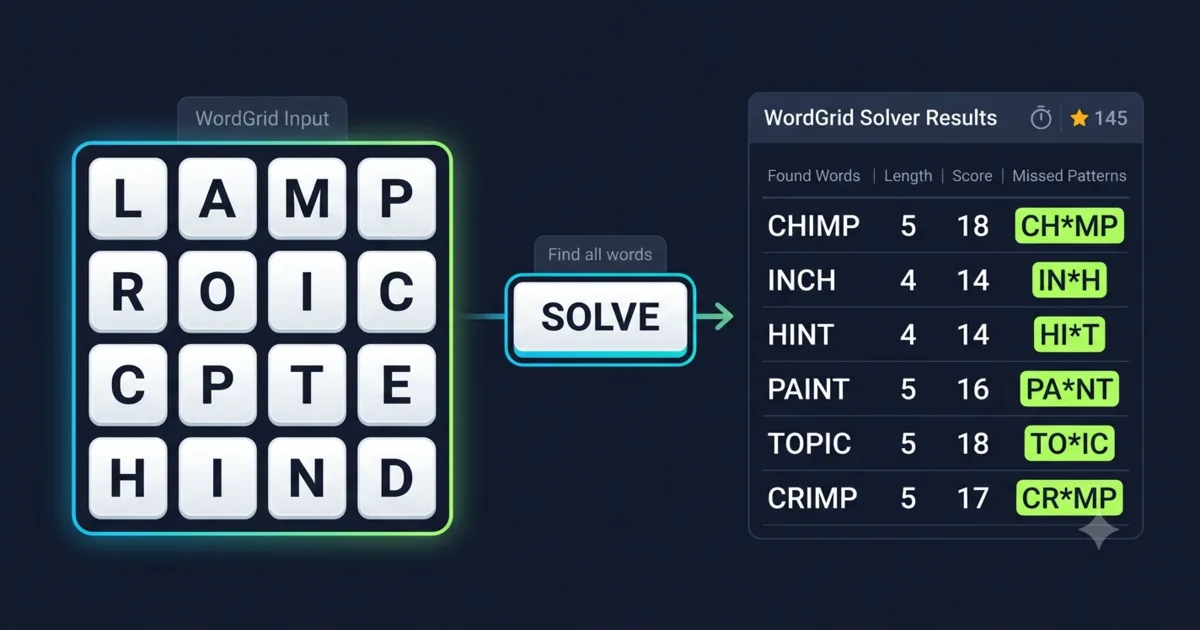
Review loop
The best solver habit is simple: play first, solve later, then study the words and patterns you keep missing.
If you are still learning the game, start with Boggle Rules for Beginners. If you want the high-frequency words that matter most while solving, open Most Common Boggle Words.
How to Use a Boggle Solver
- Play your game first. Finish a Timed or Zen practice board on your own before you review it.
- Note your grid. Write down or screenshot the letter arrangement.
- Enter letters into the solver. Input your grid row by row.
- Review the results. See all possible words, their scores, and what you missed.
- Learn from missed words. Study patterns, letter combinations, and vocabulary you didn't spot.
Solver Review Loop
What a Boggle Solver Shows You
Complete Word List
Every valid WordGrid word found from the submitted board, organized by length and point value for easy analysis. The total depends on the letters and board size.
Scoring Breakdown
Total possible points, point distribution by word length, and what percentage of available points you achieved. Shows whether you missed high-value words or just many words.
Missed Word Analysis
Words you didn't find, categorized by why you missed them (diagonals, letter clusters, long words, extensions). This identifies specific areas to improve.
Pattern Insights
Common letter combinations, high-value word locations, and scanning path suggestions. Helps you understand grid structure and optimal search patterns.
Best Way to Use a Solver
Confirm what counts as adjacent, how Qu works, and why repeated tiles are not allowed.
Use the scoring guide to separate missed high-value words from harmless misses.
Build the word families and valid-word instincts that help you miss fewer answers next time.
Pair solver results with common words by letter and high-value endings.
Paste a board, see every valid word, and turn the result into a practice review.
Using Solvers for Skill Development
Boggle solvers are powerful learning tools when used correctly:
Daily Review
After each Daily, use a solver to see what you missed. Review the complete word list and study missed patterns. Track your improvement over time by comparing your percentage of possible words found.
Pattern Recognition Training
Study solver results to learn common letter clusters (TH, HE, IN, ER) and word endings (-TION, -NESS, -MENT). Over time, you'll start spotting these patterns during games instead of missing them.
Diagonal Scanning Practice
Solvers reveal which diagonal words you missed. Use the routes to identify this weakness and improve your scanning coverage.
Vocabulary Building
Solver results include valid words you might not know. Review these to expand your vocabulary. Focus on high-frequency game words that appear regularly in grids.
How Boggle Solvers Work
The algorithm:
- Grid input: Accept square grids of letters
- Path generation: Create all possible paths following Boggle adjacency rules (8 directions, no repeated tiles)
- Word extraction: Extract letter sequences from valid paths (3+ letters minimum)
- Dictionary validation: Check each sequence against a comprehensive English dictionary
- Scoring calculation: Apply current WordGrid scoring: 3 letters = 1 point, 4 = 2, 5 = 4, and 6 = 6.
- Result organization: Sort by length, score, and alphabetically for easy review
Advanced solvers can process 1,000+ paths per second, checking millions of letter combinations in under a second.
Solver Ethics and Fair Play
❌ Not Fair: During Play
Using a solver while playing is cheating. It defeats the purpose of the game, violates the spirit of fair competition, and doesn't help you improve. You won't build skills if you rely on answers.
✅ Fair: After Games
Using solvers after completing games is excellent practice. Review what you missed, study patterns, and learn vocabulary. This accelerates skill development and is how most competitive players improve.
What Makes a Good Boggle Solver
Essential Features
- • Accurate dictionary
- • Current scoring rules
- • Complete word list
- • Fast processing
- • Easy input method
Learning Features
- • Missed word analysis
- • Pattern breakdown
- • Scoring insights
- • Vocabulary highlights
- • Export results
Frequently Asked Questions
How does a Boggle solver work?
A Boggle solver takes a square grid and systematically checks all possible letter combinations against the current WordGrid dictionary. It follows adjacent paths, requires at least 3 letters, and does not reuse tiles. It supports 4×4, 5×5, and 6×6 grids.
Is using a Boggle solver cheating?
Using a solver during competitive play is cheating. However, solvers are valuable learning tools when used after a game to see what you missed, analyze patterns, and improve vocabulary. Many players use solvers to review the Daily board.
How many words can a Boggle solver find?
The result count depends on the letters and board size. The WordGrid solver supports 4×4, 5×5, and 6×6 grids and identifies every route valid in the current WordGrid dictionary.
Can I use a Boggle solver to practice?
Yes, Boggle solvers are excellent practice tools. Use them to review the Daily board, analyze grid patterns, learn new vocabulary, study word extensions, and identify weak scanning areas. Solvers accelerate skill development when used as learning tools.
Play First, Solve Later
Build your skills by playing honestly. Use solvers after games to analyze and improve. Start a game now.