Boggle Rules for Beginners: How to Play, Score, and Win
8 min read · Updated July 2026
If you're searching for the rules of Boggle or wondering how to play Boggle, this is the fastest place to start. The game looks busier than it is: a square grid, words built by connecting adjacent letters, and a choice between Timed or Zen practice.
Short version: find words of 3+ letters, move only to neighboring tiles, never reuse the same tile inside one word, skip proper nouns and abbreviations, and score more for longer words.
The good news? The rules are simpler than they look, and the core mechanics are the same whether you call it Boggle or word grid.
Once the rules make sense, the best next step is to play a round and then move to the scoring sheet, the dictionary guide, or how to find more words.
After you learn the rules
The fastest way to make the rules stick is to play one board, open the solver, and then study the most common words and pattern library pages.
The Setup: A 4×4 Grid
Every game starts with a grid of 16 letters arranged in 4 rows and 4 columns. In the original board game version, these come from shaking 16 dice in a plastic dome. In online versions like WordGrid, the letters are generated by a seeded random algorithm — but the idea is the same.
Here's an example of what a grid might look like:
Notice the Qu tile in the bottom-left. In Boggle, Q almost always appears as “Qu” because English words almost never use Q without a U following it. It takes up a single cell but counts as two letters when spelling words.
How Letters Connect
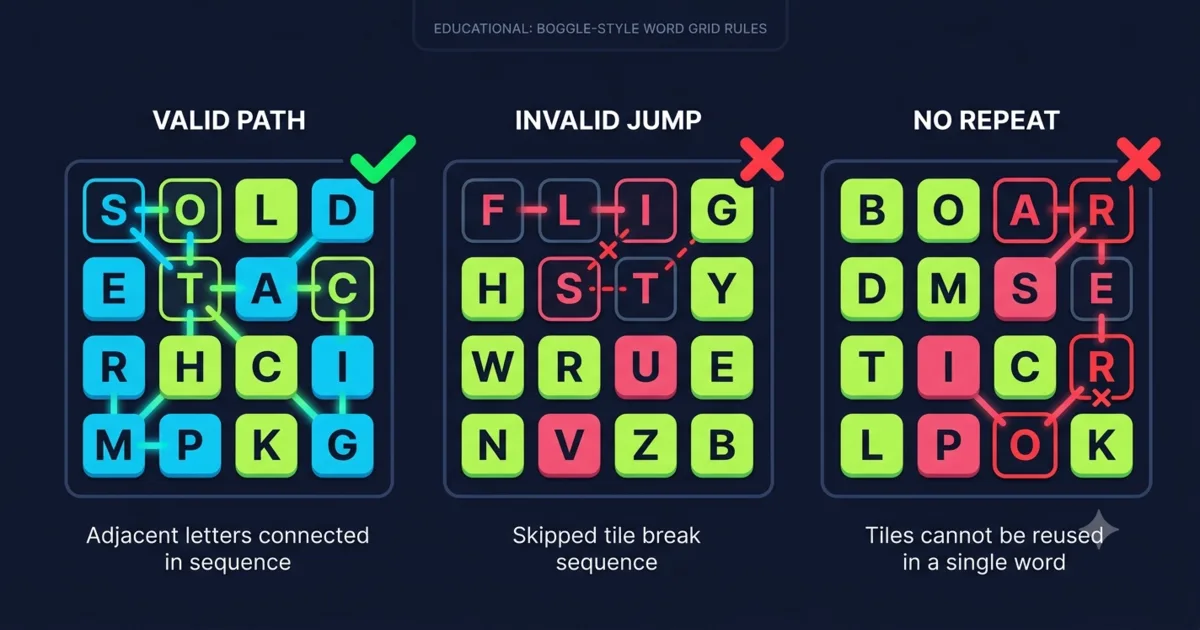
This is the core mechanic, and it's the part that confuses people the most. To spell a word, you connect letters that are adjacent to each other. “Adjacent” means any of the 8 surrounding cells:
- Left, right, up, down (the 4 direct neighbors)
- The 4 diagonals (top-left, top-right, bottom-left, bottom-right)
Think of it like a king in chess — it can move to any of the 8 surrounding squares. You trace a path from letter to letter, spelling out a word as you go.
Example: Starting from the T in the top-left of the grid above, you could trace:
- T → A → P = “TAP”
- T → A → P → S = “TAPS”
- T → E → A → R = “TEAR”
- T → R → E → I → N = “TREIN” (not valid!)
The path can zigzag in any direction. But each tile can only be used once per word.
What Counts as a Valid Word?
There are three rules:
- Minimum length of 3 letters. Two-letter words like “AT” or “GO” don't count, even though they're real words. The shortest acceptable word is 3 letters.
- Must be in the dictionary. Proper nouns (“Paris”, “Google”), abbreviations (“TV”, “ASAP”), and foreign words generally don't count. If it wouldn't be in a standard English dictionary, it's not valid.
- No repeating tiles. You can't use the same letter tile twice in one word. If there's only one “T” on the board, you can't spell “TENT” (you'd need two T's in reachable positions).
One thing that trips people up: the same word can't be submitted twice. Once you've found “STAR”, submitting it again earns nothing. But different forms of the same root — STAR, STARS, START — are all separate words and all valid.
How Scoring Works
Points scale with word length, and longer words are worth dramatically more per letter. Here's the current scoring table used in WordGrid:
| Word Length | Points | Real Example |
|---|---|---|
| 3 letters | 1 pts | CAT, RUN, THE |
| 4 letters | 2 pts | PLAY, STAR, WORD |
| 5 letters | 4 pts | QUEST, TRAIN, BOARD |
| 6 letters | 6 pts | PLAYER, GARDEN, ACTION |
Notice the jump from 4 letters to 5: that's 2 points to 4 points — double. A single 5-letter word is worth as much as four 3-letter words. This is why experienced players stop chasing tiny words once they spot something longer.
The current WordGrid word list contains words through 6 letters. The table above is the point system players can use today.
If you want the full points table with examples and winning score ranges, open the Boggle scoring sheet.
The Clock
Timed mode adds a clock when you want a faster scan. Zen mode lets you work through the same route rules without a clock.
In WordGrid, you can also choose no-timer “Zen” practice if you just want to relax and find words at your own pace. The Daily board gives everyone the same board for the day.
What to Learn After the Rules
Learn the exact point table and why 5+ letter words matter so much.
See what counts as a valid word and which word families show up most.
Review missed words after a game and turn them into practice material.
Use the rules right away on a timed, Daily, or Zen board.
One Tip Before You Start
Don't overthink it. A lot of beginners sit there staring at the grid trying to find the perfect 7-letter word. Meanwhile they're missing three easy 3-letter words right in front of them.
The best approach for your first few games: grab every short word you can see, then go back and look for longer ones. Speed beats perfection. You'll naturally start spotting longer words as you play more.
Once you're comfortable, jump into the game or keep reading:
- Play Word Grid Online Free — start a practice round immediately
- How to Find More Words — six specific techniques for spotting words faster
- Word Grid Strategies — scoring math, time management, and word families
Play Your First Game
You know the rules now. The best way to learn is to just play a round — you'll pick it up in about 30 seconds.