Word Grid Pattern Library
This guide turns scattered word-finding tips into a simple pattern library. Learn the handful of prefixes, suffixes, and board cues that show up again and again in word grid puzzles, then use them to scan faster in live play.
Quick answer
If you want to find more words in a grid, scan for a small set of repeatable patterns: common prefixes, common suffixes, plural S endings, verb endings, and Qu. The best players do not hunt every letter equally; they keep reusing pattern families until the board runs dry.
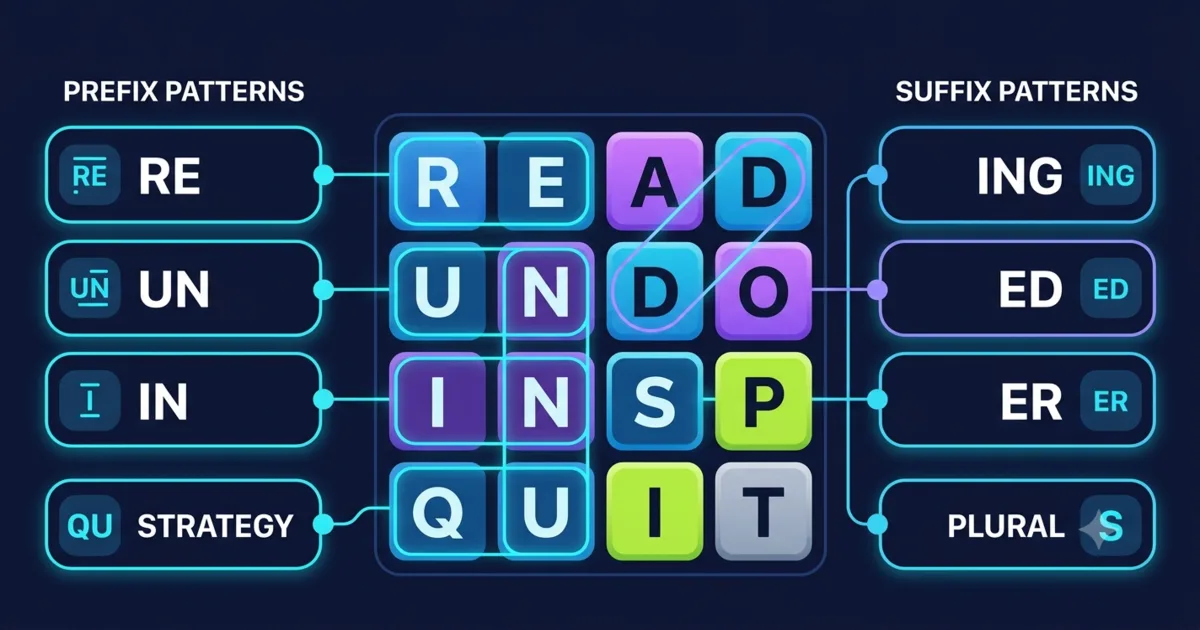
Prefixes are the easiest way to turn one base word into a family. If you see a likely starting stem, test the front of the board for extensions before moving on.
Suffixes turn medium words into score-efficient longer words. Once you find a base word, ask whether the board can support a longer ending.
Plural endings are one of the fastest low-friction gains. If the board has an S nearby, check every noun-like word for a cheap extra point.
Verb families often live in the same neighborhood. A single stem can turn into multiple valid answers when the right suffix is present.
Qu is a special-case pattern because it rewards early attention and often opens high-value branches of the board.
Long stems are where score jumps happen. When you discover a 4-letter base, immediately test whether the grid can support one more step.
Pattern drill shortcuts
Deep dives
If you want one pattern per page, start here. Each deep dive is short, practical, and easier to revisit later.
Prefixes
Prefixes are strong because they let one stem expand into several answers. If you see RE, UN, IN, or PRE near a promising start, stop looking for isolated words and start looking for families.
How to scan prefixes
- Start with the first two letters of every obvious long stem.
- Test whether the start can grow into a longer family word.
- Check whether the same stem appears in more than one path.
- Use the solver when the board is crowded and your eyes miss the branch.
Suffixes
Suffixes are the cleanest way to convert a medium word into a scorer. Once you have a base word, check whether the board can support -ING, -ED, -ER, -LY, or a plural S without forcing a bad route.
Qu strategy
Qu behaves differently from every other tile because it compresses two letters into one cell. That makes it a high-priority scan target whenever it appears.
Word families
The biggest retention boost usually comes from seeing one word as a family instead of a single answer. When you find a stem, ask what the board can support around it: singular, plural, tense changes, and nearby prefix additions.
Fast scan checklist
- Check Qu, then rare anchors.
- Find one long stem and try to extend it.
- Test plural S and common endings.
- Revisit any word that looks family-like.
- Finish with the solver or archive to study the board shape.
Next steps
Use this pattern library with the live game and the review tools. The best learning loop is simple: play, inspect the missed words, review the archive, and come back with one pattern to improve.